


“Do I really need x-rays again?” It is a fair question, and one we hear in our Kinston office almost every day. The honest answer: it depends on your mouth, not a calendar. Here is how we decide, and what the guidelines actually say.
The Short Answer
If your teeth are healthy and you have not had a cavity in years, you probably need bitewing x-rays every one to three years. If you are cavity-prone, have gum disease, or are getting orthodontic or implant work, you will need them more often. Nobody should get a full set of x-rays every six months just because it is on the schedule.
The American Dental Association and the FDA publish selection criteria that dentists follow. At Carlyle Dental, Dr. Ricky Carlyle uses those criteria plus your history to set a personal schedule.
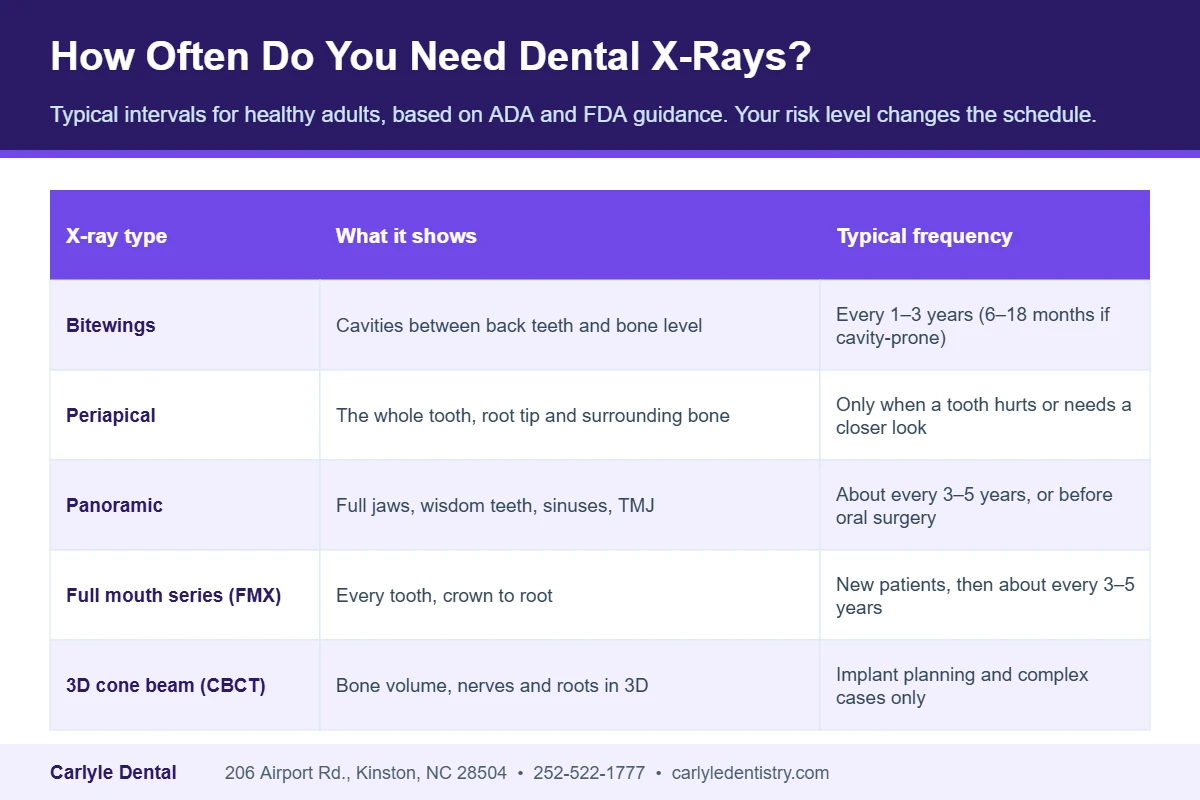
Dental X-Ray Schedules by Risk Level
Adults With Low Cavity Risk
No new cavities, healthy gums, good home care. Bitewings every 24 to 36 months. A full mouth series or panoramic image roughly every three to five years.
Adults With Higher Risk
Dry mouth from medications, frequent snacking, recent cavities, lots of crowns or fillings, or active periodontal disease. Bitewings every 6 to 18 months, because decay can progress quickly under those conditions.
Children and Teens
Kids get cavities faster than adults, and their mouths change every year. Low-risk children usually need bitewings every 12 to 24 months once the back teeth touch. Teens often get a panoramic image to track wisdom teeth. Ask us about sealants, too. They cut cavity risk enough that x-ray intervals can stretch.
What Each Type of X-Ray Finds
Bitewings catch cavities between back teeth, where no mirror or explorer can reach. Periapical images show the entire tooth down to the root tip, which helps when a tooth aches or might need a root canal. Panoramic images show both jaws, the sinuses and the jaw joints in one sweep, which matters for TMJ treatment and extractions.
We also use a Planmeca 3D cone beam scanner when we need to see bone in three dimensions. That is mostly for dental implant planning, where we have to measure bone height and map nerves before placing anything. Wondering why we image front teeth too? We explain that in do I need x-rays for both front and back teeth.
How Much Radiation Is in a Dental X-Ray?
Less than most people expect. A set of four digital bitewings delivers roughly the same dose you absorb from natural background radiation in a single day. A full mouth series is in the same range as a cross-country flight.
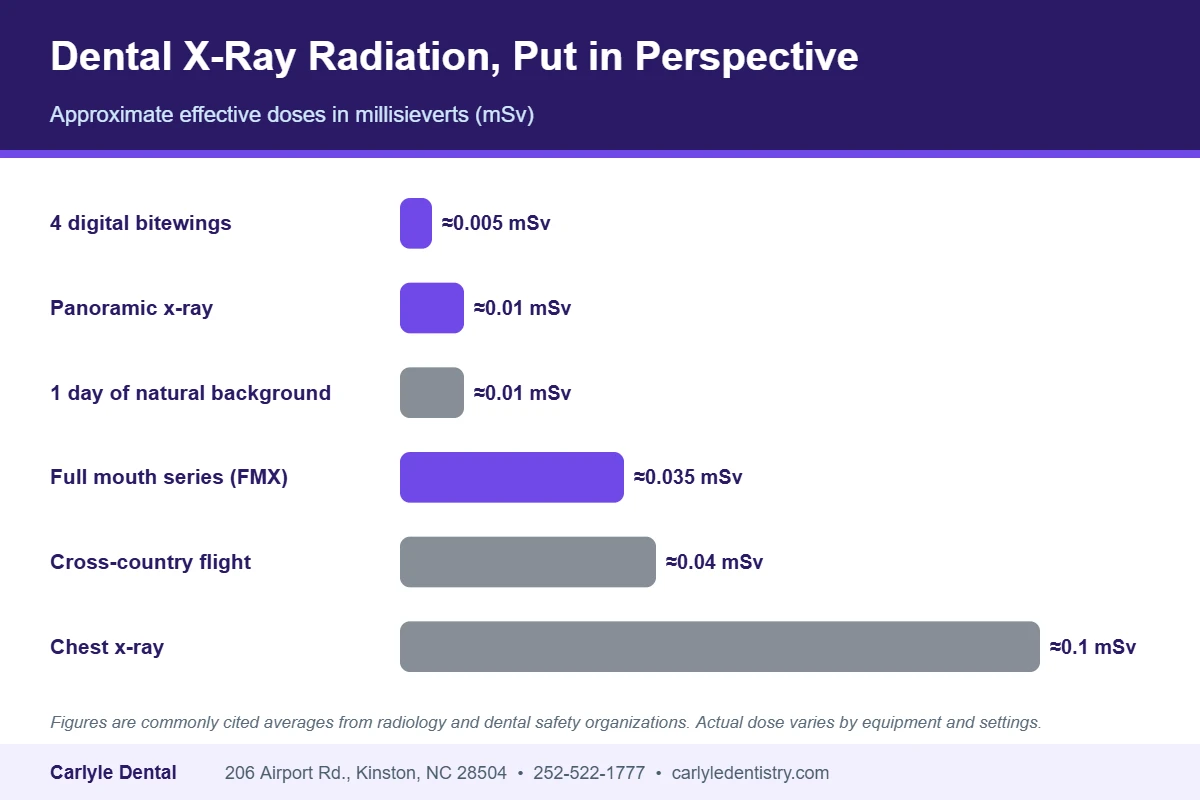
We keep it that low on purpose. Our digital sensors need far less exposure than old film, we only take images that will change a treatment decision, and we skip duplicates if your previous dentist sends recent films. Moving to Kinston from another office? Have them forward your x-rays before your first visit.
Why Skipping X-Rays Can Cost More
A cavity between two molars can grow for a year without hurting. By the time you feel it, a simple filling may have become a crown or a root canal. Bone loss from gum disease is silent, too. X-rays turn those surprises into small, inexpensive fixes.
Cost is often the real reason people put them off. Most insurance plans cover bitewings once a year and a full series every few years. No insurance? Our Dental Gym membership bundles routine x-rays, exams and cleanings into one yearly plan.
Dental X-Ray Questions From Our Patients
How often should you get x-rays at the dentist?
Most healthy adults with no new cavities need bitewing x-rays every one to three years. If you get cavities often, have gum disease or have a lot of dental work, we usually take them every 6 to 18 months.
How often are bitewings taken?
Bitewings are the most common dental x-ray. Low-risk adults typically need them every 24 to 36 months, low-risk children every 12 to 24 months, and anyone at high risk for cavities every 6 to 18 months.
How often should panoramic x-rays be taken?
Many dentists take a panoramic x-ray about every three to five years, plus whenever we need to check wisdom teeth, plan oral surgery or evaluate jaw pain.
What is an FMX in dentistry?
FMX stands for full mouth series. It is a set of bitewing and periapical images that together show every tooth from crown to root. We usually take one at a new patient visit and repeat it every three to five years.
Are dental x-rays safe during pregnancy?
Dental x-rays use a very small, focused dose, and medical guidance considers them safe during pregnancy when they are needed. We still postpone routine images when they can safely wait. Tell us if you are expecting.
Can I refuse dental x-rays?
You can. We will explain what we may miss without them, since cavities between teeth and bone loss do not show up in a visual exam. Most patients choose to keep a basic schedule once they see how low the dose is.
Not sure when your last x-rays were? We will check your records and only take what you actually need. Schedule a checkup or call 252-522-1777. We serve Kinston, Greenville, Goldsboro, La Grange and Eastern North Carolina.